Euring banner National schemes link Research link Meeting link Data and codes link About Euring link
  

Bird Ringing for Science and Conservation

EURING - The European Union for Bird Ringing

Birds do not respect national boundaries, so international co-operation is required in order to study them effectively. EURING is the organisation which enables co-operation in all scientific aspects of bird ringing
within Europe. All European bird ringing schemes are members. The EURING Board (Chairman, Vice-chairman, General Secretary, Treasurer, and from three to five other members, all elected by the ringing schemes) meets at least once a year. A general meeting, for representatives from all the schemes, is held every two years.

EURING was founded in 1963. By 1966 it had defined and published the EURING Exchange Code allowing easy data transfer between schemes and simplified data analysis. Developments in technology allowed an enhanced version of this code to be published in 1979 with further development of the code 2000.

High-quality, quantitative methods are essential for research based on bird ringing. For this reason, EURING encourages the development of statistical techniques and computer software specifically to handle the particular problems involved in the analysis of data gathered through bird ringing. EURING organises technical conferences
every few years attracting specialists from all over the world. They have, so far, concentrated on the use of ring recovery data for research on avian population dynamics.

Through pan-European ringing projects, we can increase understanding of bird populations. EURING organises projects which can involve many ringers across the continent. For example, the Swallow Project aims to discover more about the species‘ breeding, migrating and wintering strategies. A European-wide constant effort EURING – The European Union for Bird Ringing ringing programme is being developed to give annual changes in abundance, productivity and survival for many species.

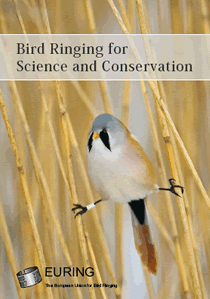
Photo © Mark Grantham

The EURING Data Bank is hosted by the British Trust for Ornithology at Thetford, UK.

The EURING Data Bank (EDB) was established in 1977 as a central repository for European ringing recovery records. Until 2005, it was hosted by the Netherlands Institute of Ecology. It is now held by the British Trust for Ornithology. Recovery data are made available to many researchers. Data have been used to study a wide variety of aspects of ornithology – migration routes and strategies, survival and dispersal rates, the impact of human activity on bird populations and the impact of bird activity on humans. Data have been supplied to amateur
researchers, research students, professional ornithologists and research organisations. Many papers have been produced using the data.

The EDB is also compiling archives of annual totals, by species, for all ringing schemes; of data supplied to researchers, and of publications using EDB data.

EDB Holdings
Total number of records
Total number of species
Number of species with over 10,000 records
Number of species with 1,000 to 10, 000 records
Number of ringing schemes submitting computerised recovery data


4,743,373
485
87
119
28

 
How to obtain data from the EDB?
Full details of the EDB dataset and the system for applying to analyse data from the EDB are available on-line. http://www.euring.org/edb
 

Achievements of EURING

  • Undertakes applied analyses of ringing data at a European scale
  • Co-ordination of a network of over 500 Constant Effort Sites throughout Europe
  • Promotes European-wide research projects involving networks of volunteer ringers
  • Promotes the development of statistical and computing methods for the analysis of ring ringing data
  • Provides guidelines and standards for bird ringing
  • Devised a standard code for the computerisation and exchange of ring recovery data
  • Established the EURING Data Bank
  • Facilitates communication between schemes, ringers and members of the public through its website


Contents


BTO Blue line

Click here to email webmaster

Last updated 16 December, 2008
© European Union for Bird Ringing
This site is hosted by the BTO on behalf of EURING