Euring banner National schemes link Research link Meeting link Data and codes link About Euring link
 

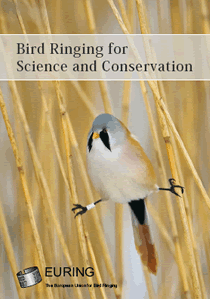
Bird Ringing for Science and Conservation

Bird Ringing as a monitoring technique

In 2001, EU countries committed themselves to halt biodiversity decline by 2010, and to evaluate this target. Beyond legal obligation, monitoring – the study of variation in space and time of bird populations – is a tool for acquiring knowledge on which good conservation practice may be based. Monitoring is also the main source of information to alert the general public on the status of biodiversity and thus contributes to conservation by affecting policy and behaviour.

The general aim of monitoring is to document changes in numbers. For most bird species, direct counting is far more cost effective than ringing to achieve this aim. But counts alone are inefficient for determining mechanisms and for inferring causes. From one year to another, change in population size is the result of a long list of demographic events: reproduction, juvenile survival, dispersal, recruitment (new individuals entering the population), adult survival, etc. Most of them can be monitored efficiently through ringing. Hence, an appropriate monitoring system using ringing may be able to determine which of productivity or survival drives population changes, whether population are regulated and thus more prone to be resilient to global changes, etc. Moreover, long-term time series allow correlation of demographic rate variation with climatic fluctuation. Combined with other methods of bird monitoring, monitoring by ringing allows prediction of the fate of a bird population facing climate changes.

Common Tern © Emile Barbelette

Ringing data can be used to determine survival rates of long-lived seabirds such as the Common Tern.

Monitoring through ringing may either rely on intensive co-ordinated schemes or be the outcome of the accumulation of long-term database. The former is best illustrated by the “Constant Effort Site” scheme (CES; also known as “Monitoring Avian Productivity and Survival” in North America, an acronym that speaks for itself). Initiated in 1983 in the UK and Ireland, CES is currently organised in 16 EU countries, on 600 sites where over
100,000 birds are caught annually. CES is unique in producing annual indices of reproductive success of more than 30 species throughout Europe. CES data have, for example , shown that hot weather in spring was negatively affecting productivity of already declining species. This suggests a link between climate warming and
long term population trend through reproductive success for a large number of species. The production of annual indices of productivity at a European scale is under study and is likely to be achievable in the near future. The long term ringing database is also most useful to monitor changes, through time, of key demographic parameters of bird population. Among them, changes in migration route, migration timing and migration probabilities are the most evident. Last but nor least, one of the few globally threatened bird species for which Europe has the main
responsibility, the Aquatic Warbler, is almost entirely monitored through ringing, allowing us to determine the stability of the stopping-over network from Western Russia and Poland to Spain.

Great Tit © Matthias Kestenholz

Great Tits easily accept to breed in nest-boxes which renders them accessible for ringing. Hundreds of thousands have been ringed for long-term population studies that provided fundamental insights into evolutionary processes, population dynamics, breeding biology and behavioural ecology.

The most useful monitoring schemes are those that cover a large scale and that may be run in the long term. Although CES is showing the way, there is considerable room for improving the efficiency of monitoring by ringing. Another direction of improvement is the continuous integration of different monitoring schemes. This means more organisation and support for the volunteers who make up the only network able to monitor biodiversity throughout Europe. This is achievable by encouraging scientists to work in close association with ringing schemes.

Contents


BTO Blue line

Click here to email webmaster


Last updated 02.12.2010
© European Union for Bird Ringing
This site is hosted by the BTO on behalf of EURING