Euring banner National schemes link Research link Meeting link Data and codes link About Euring link
 

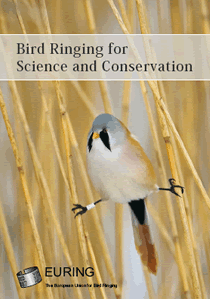
Bird Ringing for Science and Conservation

Bird Ringing and Global Climate Change

Birds as highly mobile and easily observable organisms are extremely responsive to climatic changes. They were among the first organisms that made it obvious to scientists and the public that climate is now changing at a remarkable rate. Earlier spring arrival of migrants, earlier onset of the breeding season, a northward shift of breeding areas and an increase in winter reports of migratory species gave clear evidence for a general rise in temperature over most of Europe.

In several countries bird ringing has been in constant use for over 100 years and data at national ringing schemes cover large geographic areas. The recovery database of birds from Britain and Ireland was used to calculate indices of migratory tendency which can be used for a variety of analyses, including detection of changes in migratory behaviour. Based on the same dataset of ring recoveries in Britain and Ireland, relationships were shown between mean wintering latitude and climate variables. In a comparable analysis on the German ring recoveries of 30 species evidence was found for significantly increased proportions of winter recoveries within a distance less than 100 km in nine species. Evidence for reduced mean recovery distances between breeding and wintering areas was found in five species and a tendency towards wintering at higher latitudes was found in 10 species.

Bee-eaters © Philippe Emery

During the last decades Bee-eaters, a species of the warmer regions of Europe and Africa, appeared for breeding in good numbers in Central Europe. Ringing projects will help to understand if new northern breeding colonies are self-sustainable or if these colonies need a steady influx from productive southern parts of the population.

Although heterogeneity of ring recovery data in terms of ringing activity, recapture, re-sighting effort, recovery and reporting probabilities of recoveries on a temporal and spatial scale are problems for these types of long-term
analyses the data from bird ringing offer promising possibilities. First, ringing and recovery databases cover larger areas and longer time-spans than most single studies. Second, in contrast to pure observations and bird counts, individuals with deviant behaviour (like wintering in northern latitudes by migrants) can be assigned to distinct populations. Third, the datasets are readily available in standardised, electronic format. Thanks to the co-ordinating efforts of EURING, analyses of changes in migration behaviour of some species might cover many decades and large geographical areas. Furthermore the success of wintering attempts in northern latitudes, as well as fitness consequences of changed behaviour in response to any environmental change can only be measured properly when the bird is individually marked and can be recognized.

Swift © Tomi Muukkonen

Swifts are among the species with increased reports of two subsequent broods instead of a single one per breeding season. But are the parents of both broods identical or did another pair start a late brood in the early abandoned nest site of their predecessors? Studies with individually marked birds can help to find the answer.

Besides the current strong tendency to assign almost all observed changes in bird behaviour to climate change it must be kept in mind that also changes in land use, winter feeding, availability of rubbish dumps and many other environmental changes may affect the position of wintering areas and the timing of breeding behaviour. Standardized data from ringing projects and the insights into life histories of individuals, as shown by ring
recoveries, will help to entangle this complex framework.


Contents


BTO Blue line

Click here to email webmaster


Last updated 02.12.2010
© European Union for Bird Ringing
This site is hosted by the BTO on behalf of EURING