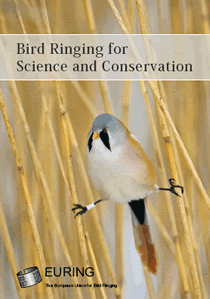
Bird Ringing for Science and Conservation
Bird-transmitted diseases
When avian influenza virus of the H5N1 type started
its way from southeast Asia westwards into Europe in 2005, the public
interest of movements of wild birds reached a peak as has never
been seen before. Newspapers and broadcasting stations asked for
bird migration maps showing possible links between avian influenza
outbreak regions and European countries. Although the complexity
of bird movements made it difficult for ornithologists to give simple
answers many insights into bird migration phenology could be conveyed
to the public. The results presented were largely based on recovery
data from bird ringing.
Not only mass media showed an increased interest
in bird ringing results but also the European Commission and many
national administrations also became aware of the value of bird
ringing and even funded bird ringing projects and data analyses.
This general interest in bird movements was driven by the assumption
that wild birds – and especially waterfowl -are the main carriers
of avian influenza and thus form the main risk for the introduction
of the disease into countries and into poultry holdings. Again,
largely based on bird ringing results, ornithologists were able
to show that there are discrepancies between the movements of birds
and the movement of H5N1avian influenza virus. This demonstrates
the important fact that movements of wild birds are not the only
– and probably not the most important – source of avian
influenza outbreak risk. Later, virologists reconstructed pedigrees
of the outbreaks by analysis of parts of the viruses’ genomes
and supported this point of view. One famous example was a Whooper
Swan which was among the first victims of the avian influenza outbreak
on the German island of Rugen. This bird was marked with an individually
numbered neck collar attached in its breeding grounds in Latvia
and it was seen alive more than two weeks before the outbreak in
the Rugen area. This bird, and some others with individual marks,
told scientists a lot about transmission and epidemiology of avian
influenza virus and helped to develop effective, but not excessive
measures of defence against this disease.
 |
|
More than half of the birds tested positive
for H5N1 avian influenza virus in the 2006 European out-break
were Mute Swans. Thanks to ringing programs, the movements
of this partly migratory species in Europe is fairly well
known.
|
Besides the spectacular H5N1 avian influenza outbreaks,
scientists study many aspects of bird-transmitted diseases for two
main reasons. Firstly, birds can be highly mobile and effective
hosts and dispersers of diseases which may also effect plants, livestock,
or humans. Besides Avian Influenza there is a wide range from West
Nile Virus over Cercarial Dermatitis (“Swimmer’s Itch”)
and Psittacosis (“Parrot Disease”) to humming bird-transmitted
floral mites causing plant venereal diseases. Tracking of individuals,
marked by bird rings, through space and time help us to understand
the ways of spread and transmission of the disease. This helps to
develop effective defences for the benefit of man, livestock and
plants.
|
Eurasian Teal is one of the 17 species for which EURING
has analysed recoveries in relation to High Pathogenicity
Avian Influenza. |
|
|
Secondly, the easy accessibility of birds, the
large background knowledge that is already available about bird
biology and the potential of a large community of amateur ornithologists
gathering information make birds and their diseases ideal models
for understanding the biology of hosts and parasites. With the help
of thousands of amateur ornithologists watching House Finches in
their gardens in the United States, scientists of the Cornell University
(Ithaca, NY) were able to follow, over a whole continent, the dynamics
of mycoplasmal conjunctivitis, a new eye disease infecting the finches.
These observational data were completed by quantifying the effects
of the disease on host demographic parameters via capture –
mark – recapture modelling. By a similar approach –
also requiring the individual ringing of birds – it is possible
to investigate detection probabilities of disease carriers and assess
disease prevalence. Both are important factors in understanding
the co-evolution between a parasite (disease) and its host.
|