Euring banner National schemes link Research link Meeting link Data and codes link About Euring link
 

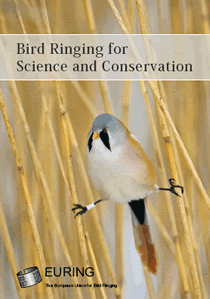
Bird Ringing for Science and Conservation

Bird Ringing in the 21st Century and the Future Role of EURING

EURING promotes research based on bird-marking in order to inform the conservation and scientific understanding of wild birds. Co-ordinated field projects and novel analyses of large-scale data will address key topics including the effects of climate change and factors responsible for the loss of biodiversity.

Throughout the Palearctic-African flyway, changing agricultural practices and land use continue to have major impacts on our bird populations. Global climate change is already affecting the phenology, distributions and migrations of many bird species, and is set to have much greater effects over the coming decades. The conservation of many migratory bird populations also requires the protection of site networks and other suitable habitat along flyways under international treaties such as the Ramsar Convention, Bonn Convention and African Eurasian Waterbird Agreement (AEWA).

To address these large-scale conservation issues we need knowledge of population dynamics and migration patterns provided by internationally coordinated bird marking. The examples throughout this brochure illustrate what has already been achieved as well as the urgent need for further research. EURING and its member schemes undertake research into factors affecting European birds throughout the Palearctic-African flyway, where appropriate in collaboration with colleagues from outside Europe. EURING will focus its future activities on three key areas in order to maximize the contribution of bird-marking to science and conservation. These are technical development and co-operation, the analysis and interpretation of large-scale data sets and the development of co-ordinated research programmes.

Stone-curlew © Mark Grantham   Colour-ringed
Stone-curlew


Common standards for field work, data storage and analysis are essential for high quality international research. EURING promotes best-practice in field protocols for the catching and examination of wild birds and in the training of ringers. We have a multi-language website for recovery reporting, and have developed the use of a common European web address on bird rings. Data from conventional bird-ringing can be enhanced by additional techniques including colour-marking, transponders, radio-tracking and satellite tracking. EURING will work to ensure that the most appropriate technologies are applied to address specific research questions. EURING will also maintain a series of conferences that promote collaboration between statisticians and biologists, leading to methods and software that provide better insights into migration patterns and the causes of population changes.

Maintaining and developing the EURING Data Bank as a unified source of European ringing and recovery data is central to EURING’s activities. EURING provides research and interpretive services based on these data and also welcomes requests for data and collaboration from other prospective analysts. EURING will also aim to ensure that this primary research is turned into advice that is of real value to policy makers and conservation practitioners. This could be achieved by, for example, providing on-line access to summary information on movement patterns and demography. The organization of co-operative bird-marking projects is expected to form a growing part of EURING’s activities. The EURING Swallow project is a recent and highly successful example of this approach (page 14). The European Constant Effort Sites (CES) scheme that is currently under development aims to monitor the abundance, productivity and survival of a range of species by standardized mist-netting (page 17). CES schemes offer the opportunity to address a range of important conservation issues such as the effects of climate change on population dynamics. The large network of volunteer ringers maintained by EURING’s member schemes offers the potential for other coordinated projects to address key conservation issues.


Contents
Next section: Reporting a Ring


BTO Blue line

Click here to email webmaster


Last updated 02.12.2010
© European Union for Bird Ringing
This site is hosted by the BTO on behalf of EURING