Euring banner National schemes link Research link Meeting link Data and codes link About Euring link
 

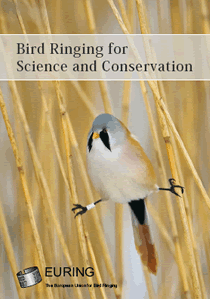
Bird Ringing for Science and Conservation

Bird ringers and ringing centres

By definition, “bird ringers” or “ringers” possess a ringing licence. Though the exact way of becoming a ringer and gaining a licence differs from country to country, the basic principles are the same everywhere. Every examinee has to demonstrate his knowledge of bird identification, of sexing and ageing, the practical and administrative details of ringing, and, last but not least, the ethical and conservational aspects of this research method.

In most countries, trainee ringers have to spend a number of years of practice before ringing on their own. These years of probation and the ringing courses are of great importance in acquiring the methods of safe handling of the birds and the equipment, becoming experienced in the identification of the different, common and uncommon species. Also it takes a few years to meet all the specific, rarelyused capturing methods and to become skilled in measuring the birds.

The form and the content of the ringing licence differ according to varying legislation in the various countries. Ringing on strictly protected areas or capturing endangered species usually requires special licensing and can only be maintained by experienced ringers engaged in a particular species-conservation or study program. Moreover, some ringing centres allow ringing only for well-designed, accepted conservation programs.

Only a fairly small proportion of ringers are professional scientists. They are employed mainly by universities, using bird ringing in special research programs. A very small number of ringers are employees of ringing stations or field assistants of certain conservation projects.

Non-professional ringers form the majority (around 70 %) of the ringers’ community, and perform this activity in their spare time, as voluntary work. Most of the ringers are involved in co-ordinated projects, following the welcome general trend of designed projects in bird ringing. Without the help of these volunteers, it would be impossible to work ringing stations and maintain centrally co-ordinated projects, such as Constant Effort Sites, national and international speciesorientated projects. From the dawn of bird ringing, many millions of records
have been gathered from all over the world mainly by those tens of thousands of dedicated volunteers. This enormous field work, together with the invaluable help of all the informants, forms the basis of the numerous books, and publications, describing most of our recent knowledge of bird migration.

Bird ringing is organized by national ringing schemes. The responsibility of the national ringing schemes is to co-ordinate and canalize the ringing activities. The role of EURING is to co-ordinate analytical and field projects at a continental or flyway scale, and also to facilitate standardization and the exchange of technical information. Processing data gathered in this way, on a wide geographic scale by standardised methods, gives a much more
detailed picture of bird migration, dispersion and population trends. Regular feedback and publication of the results is essential for the thousands of volunteers.

Image © EURING

The numbers of birds ringed annually and the numbers of ringers licensed by each ringing centre. If several ringing centres operate in one state, summary figures are given. It is estimated that 115 million birds have been ringed in Europe during the 20th century and the number of recoveries now exceed 2 million.

Contents


BTO Blue line

Click here to email webmaster


Last updated 02.12.2010
© European Union for Bird Ringing
This site is hosted by the BTO on behalf of EURING