Birds freely cross political boundaries and so international cooperation is vital for research and conservation. EURING promotes international collaboration on all aspects of scientific bird ringing, particularly in Europe and along the Eurasian African flyway. Our work includes collaborative research, data sharing and scientific meetings.
EURING supports our friends in Ukraine
 We strongly condemn the invasion of Ukraine and stand in solidarity with all those in Ukraine, Russia and elsewhere who are protesting against the violence and seeking a peaceful way forward. Full statement.
International Bird Ringing Photo Contest
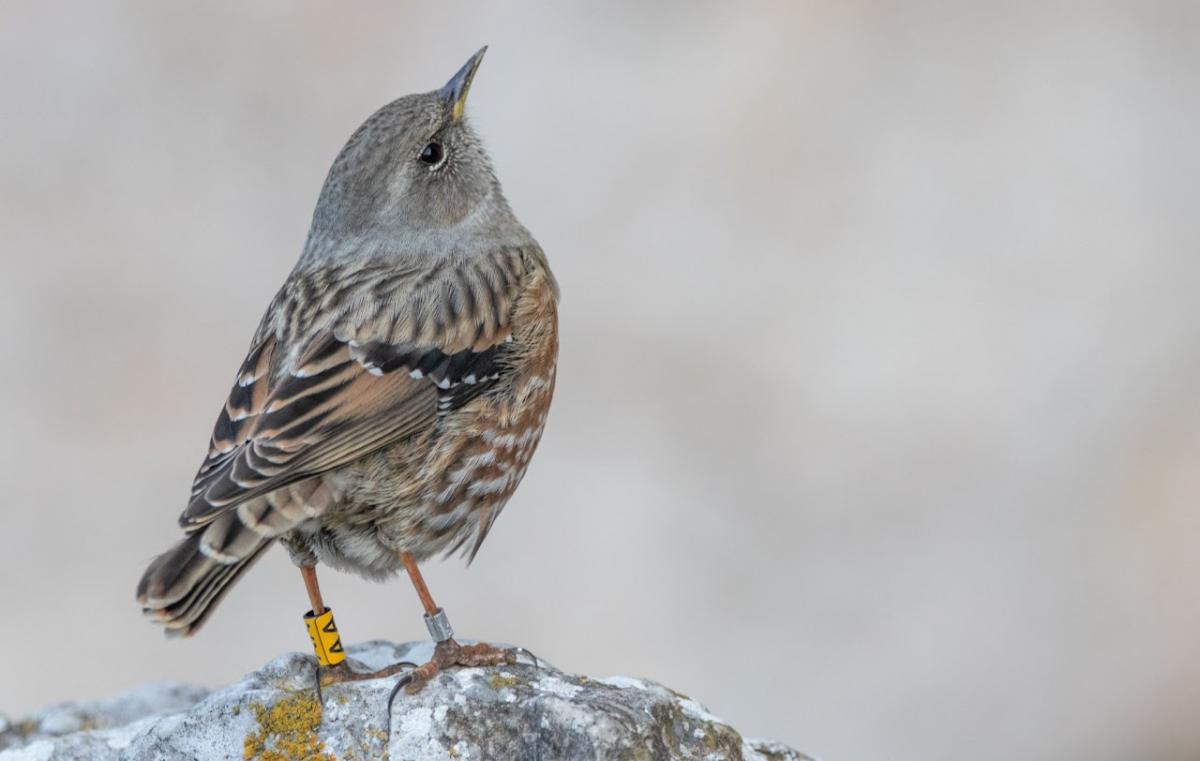 This nature photography contest is organized by the Ringing Scheme of the Aranzadi Sciences Society. The aim of this contest is to communicate the mission, vision and values of scientific bird ringing, so as to promote research based on bird ringing, particularly that related conservation. The closing date for submissions is 2 September 2024. For further information please vsist the competition website.
EFSA's Bird Flu Radar released
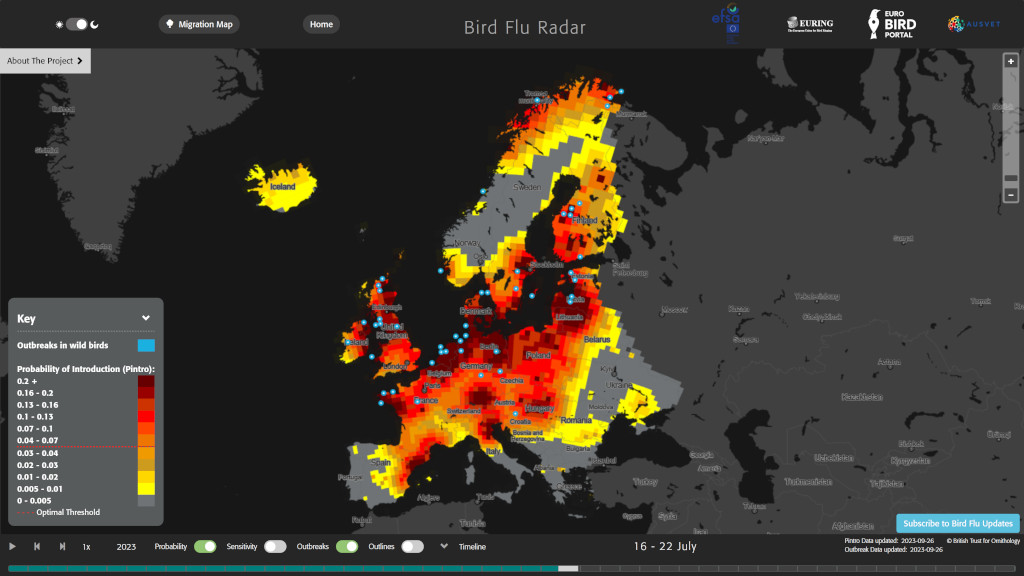 Based on models of the data on distributions and movements shown in the Migration Mapping Tool, combined with data on Highly Pathogenic Avian Influenza (HPAI) outbreaks available from ADIS, we have now developed a prototype Early Warning System for HPAI outbreaks in wild birds through a collaboration between EURING, EuroBirdPortal and Ausvet Europe. The tool is under constant development and will be further expanded in the future. You can also subscribe to receive email alerts when outbreaks are predicted in areas of interest to you. These important developments are funded through a contract with the European Food Safety Authority.
Eurasian-African Bird Migration Atlas Launched
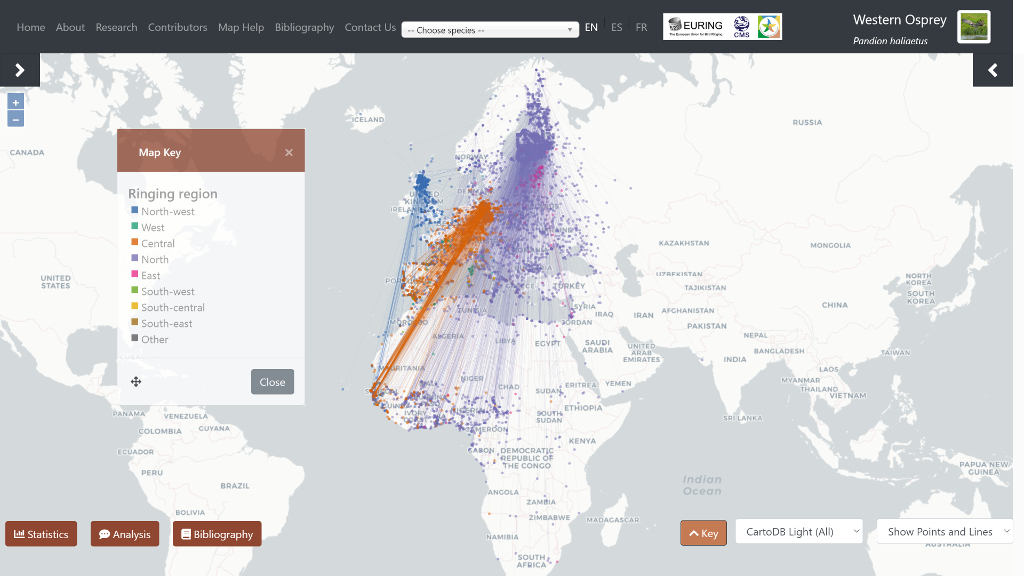 We are delighted to announce the launch of the Eurasian African Migration Atlas which provides interactive migration maps for 300 species based primarily on recoveries from the EURING databank. We have also worked with Movebank to incorporate tracking data for nearly 100 species. The Atlas also includes four research modules on topics of conservation interest and a summary of key conservation conclusions. Huge thanks to the Ringing Schemes and tracking researchers who supplied the data, to CMS for facilitating the project and to the Italian Government for financial support.
EURING Analytical Meeting April 2023, Montpellier, France
EURING is delighted to announce that the next EURING analytical meeting will be held in Montpellier, France from 17-21 April 2023. Further details are available on the Conference website.
EURING General Meeting October 2022, France
The 2022 EURING General meeting will take place from 4-6 October in Nantes and is being hosted by the French Ringing Scheme. We are very pleased to be able to meet in person again after a long period of online only meetings. This will be an excellent opportunity to celebrate the completion of the Eurasian African Migration Atlas and to plan future initiatives. Full details of the meeting arrangements and a link to the registration page are available here.
EURING/EBP/EFSA Migration Mapping Tool
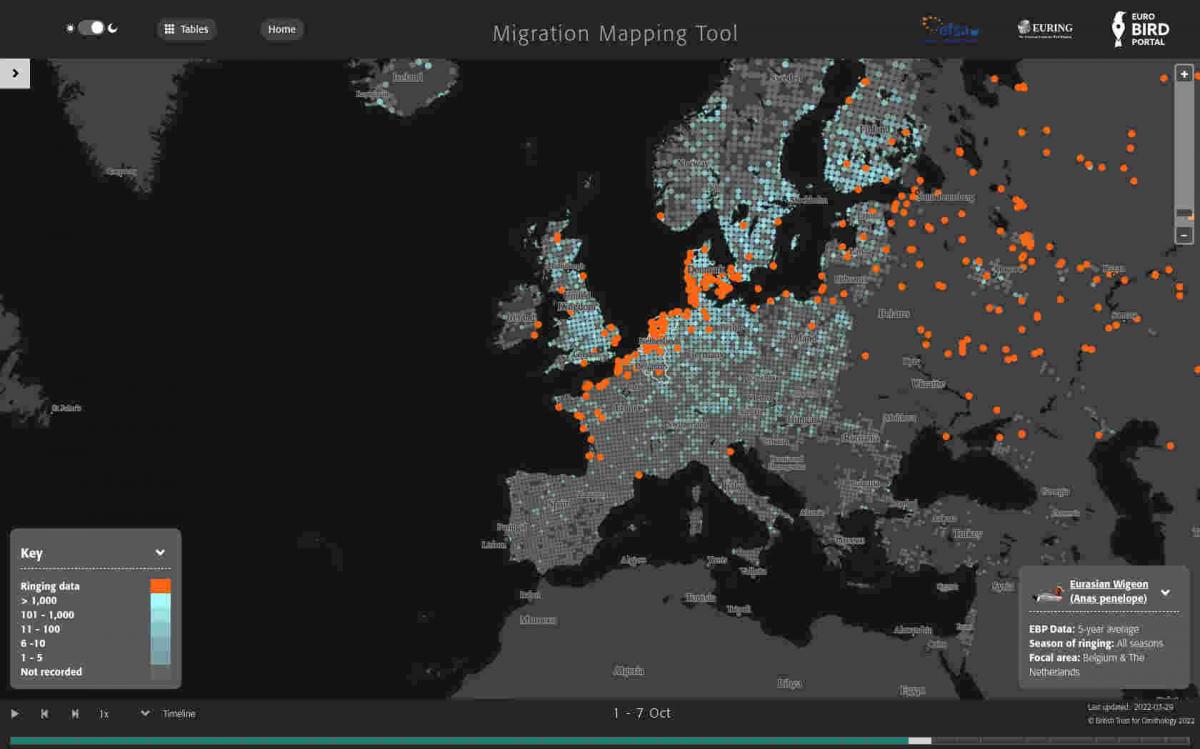 A new Migration Mapping Tool developed by EURING and EuroBirdPortal with funding EFSA, the European Food Security Authority, and been launched at the EBCC's Bird Numbers 2022 Conference in Switzerland. The new tool combines up-to-date data on relative abundance via a live data feed from EuroBirdPortal with movement data from the EURING databank. It covers 50 species, mainly waterbirds, that may be involved in the transmission of Avian Influenza and other diseases. A major objective of this tool is to inform those involved in the management of relevant disease transmission. However it also presents much useful information for those dealing with a wide range of conservation issues, and will be of interest to many birdwatchers and ringers. To view our introductory video and access the interactive tables and maps visit the Migration Mapping Tool home page.