A worldwide symbol of bird migration all across its vast geographical range and for different human cultures, the Barn Swallow is also an important bio-indicator for habitat types which are under threat in different continents.
It breeds colonially in farmlands, sharing this habitat with a concentration of bird species showing worrying population declines. Before leaving the northern hemisphere for its long migrations, the Swallow stores energy reserves during a crucial roosting phase, when the birds congregate at dusk in reedbeds, again a habitat which is facing severe reduction at a global scale.
Roosting behaviour is also typical of the winter period spent in the southern hemisphere, in vast areas of sub-Saharan Africa for the Western Palearctic populations. These areas of reeds and elephant grass are also under threat from human activities and agricultural development. The fascination of its journeys makes the Barn Swallow a very popular research subject among ringers. For all these reasons the EURING Swallow Project (ESP) was launched in 1997. During five years of activities on the breeding grounds, as well as along the migratory routes and on the wintering grounds, nearly one million Swallows have been ringed by many hundred ringers in 25 different countries in Europe, Africa, and Asia. This amazing effort has allowed the unravelling of different aspects of the lifecycle and migrations of what used to be regarded as a very well known species.
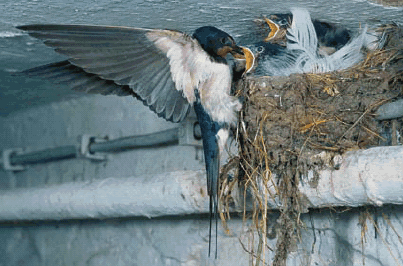 The large-scale geographical coverage has also offered a unique opportunity to test optimal migration theories. Data gathered in Italy could confirm a tradeoff between the completion of body moult and the accumulation of fat reserves during the pre-migratory roosting phase. At an intensively studied roost in northern Italy it has been shown that birds can only start accumulating fat when their body moult approaches its final stages. Optimal migration theory also predicts that birds will reach their final departure conditions just before embarking on the crossing of possible ecological barriers, like the Mediterranean and Sahara for European Swallows flying to Africa. By analysing data gathered from Finland southwards across Europe it has been possible to confirm this theory. Swallows leave Finland still with reduced fat stores, which are quite larger already in birds analysed in Switzerland. Still across Italy and Spain, the amount of fat reserves in birds in the north of these countries is significantly lower than that of swallows leaving the southernmost latitudes.
Even though it had long been thought that an aerial feeder like the Swallow would not need to store fat before migration, but rather adopt a “fly and forage” strategy, the project has shown that the amount of fat accumulation in European Swallows matches that of other long-distance songbird migrants.
The network of EURING Swallow Project roost ringing sites has also offered the first confirmation based on field data, that the amount of fat reserves at departure towards Africa is correlated to the distance that first-year and totally un-experienced swallows will have to fly across ecological barriers they have never seen before. Young swallows leaving southern Iberia, which will cross the narrow stretch of the westernmost Mediterranean and the Western Sahara, will depart with lower fat reserves than those of swallows leaving southern Italy. Those departing from Italy will fly a long distance over the sea and across the widest part of the Sahara desert, and are in fact much fatter.
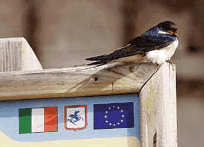 The huge number of Swallows ringed during the project has also produced a large number of recoveries and described yet unknown wintering quarters for different geographical European populations. This has also led to increased action for Swallow conservation in Africa, where huge numbers of birds were and still are killed for food in Nigeria, Central African Republic, and Congo.
Thanks also to the EURING Swallow Project, the Swallow is now, more than ever before, a global symbol not only of bird migration but also of the need for internationally based conservation efforts and strategies.